**Meta Description:** Discover the Amazon Echo Dot (5th Generation) with vibrant sounding audio, Alexa+ optimization, and smart home hub features. Complete review, specs, and why it’s the best budget smart speaker of 2024.
# Amazon Echo Dot (Newest Model) Review: The Vibrant Sounding Speaker Designed for Alexa+
Smart home technology has evolved beyond simple voice commands into sophisticated, sensor-rich ecosystems that anticipate your needs before you speak. The **Amazon Echo Dot (newest model)** represents the pinnacle of this evolution, delivering a **vibrant sounding speaker** experience packed into a compact, aesthetically pleasing sphere. Whether you’re building your first smart home or expanding an existing Amazon ecosystem, this 5th generation device offers compelling upgrades that justify its position as Amazon’s most popular Echo device.
Unlike previous iterations that prioritized function over audio fidelity, the newest Echo Dot bridges the gap between affordability and acoustic performance. With twice the bass response of its predecessor, integrated temperature sensing, and motion detection capabilities, this isn’t merely a voice assistant portal—it’s a comprehensive smart home command center optimized for the emerging **Alexa+** ecosystem.
## What Makes the Amazon Echo Dot (5th Generation) Different?
Amazon’s Echo Dot has undergone significant transformation since its debut as a hockey-puck-sized gateway to Alexa. The newest model abandons purely utilitarian design philosophy in favor of sophisticated audio engineering that rivals dedicated Bluetooth speakers twice its price.
### Revolutionary Audio Architecture
The most immediately noticeable upgrade in the **5th generation Echo Dot** is the front-firing 1.73-inch speaker driver. Previous models utilized internal firing speakers that projected sound upward, creating dispersed audio that lacked directional clarity. By reorienting the speaker architecture, Amazon has created a **vibrant sounding speaker** that delivers crisp vocals, defined mid-ranges, and surprisingly robust bass for a device measuring just 3.9 inches in diameter.
This acoustic redesign isn’t merely about volume—though the device certainly achieves impressive decibel levels for its size. The AZ2 Neural Edge processor enables real-time audio optimization, adjusting equalization based on room acoustics and content type. Whether you’re streaming high-fidelity Amazon Music, catching up on podcasts, or receiving voice responses from Alexa, the audio remains articulate and free from the tinny distortion that plagued earlier budget smart speakers.
### Sensor Integration Beyond Voice
Modern smart homes require environmental awareness beyond voice recognition. The newest Echo Dot incorporates a temperature sensor and ultrasound motion detection, transforming the device from passive assistant to active home monitor. These sensors enable contextual automation previously requiring multiple dedicated devices.
The temperature monitoring proves particularly valuable for energy-conscious homeowners. By detecting ambient temperature changes, the Echo Dot can trigger HVAC adjustments, activate smart fans, or adjust motorized blinds without additional sensor purchases. Meanwhile, ultrasound motion detection enables gesture controls and occupancy-based routines, turning lights on when you enter a room and off when you leave.
## Deep Dive into Features and Capabilities
Understanding whether the **Amazon Echo Dot newest model** suits your needs requires examining its multifaceted capabilities. Beyond playing music and answering questions, this device functions as a Thread border router, Zigbee hub, and Wi-Fi 6 extender, consolidating multiple smart home functions into a single $50 investment.
### Vibrant Sound Technology Explained
Audio engineers refer to “vibrant sound” as characterized by clarity across frequency ranges without muddiness or artificial enhancement. The Echo Dot (5th Generation) achieves this through a combination of hardware improvements and digital signal processing. The larger speaker cone moves more air than previous generations, creating perceptible bass response that adds warmth to music and authority to Alexa’s voice responses.
Stereo pairing capability further enhances the audio experience. By purchasing two units, users can create a true left-right channel separation that fills larger rooms with immersive sound. This feature, once reserved for premium audio equipment, now comes standard in Amazon’s entry-level smart speaker, democratizing high-quality home audio.
### Built-in Smart Home Hub Functionality
One often overlooked advantage of the newest Echo Dot is its role as a smart home hub. The integrated Zigbee radio allows direct connection to compatible lights, locks, and sensors without requiring separate bridge devices. This reduces network congestion by enabling local control rather than routing all commands through cloud servers.
The addition of Thread border router capabilities future-proofs your investment. As the Matter standard gains adoption across the industry, having a Thread-capable device ensures compatibility with next-generation smart home products from Apple, Google, and Samsung. This interoperability addresses one of the smart home industry’s most persistent pain points: ecosystem fragmentation.
### Alexa+ Optimization: The Future of Voice Assistants
Amazon continues developing **Alexa+**, an enhanced artificial intelligence layer promising contextual understanding and proactive assistance. The Echo Dot (5th Generation) ships hardware-optimized for these upcoming capabilities, featuring enhanced processing power and microphone arrays that improve far-field voice recognition.
Current users benefit from improved natural language processing that understands follow-up questions and complex commands. Rather than rigid “Alexa, turn on the lights” syntax, the device comprehends conversational requests like “Alexa, it’s too dark in here” or “Make the living room cozier.” This intuitive interaction model reduces the learning curve for smart home newcomers while satisfying power users seeking sophisticated automation.
## Real-World Use Cases and Applications
Theoretical specifications matter less than practical daily utility. The **Amazon Echo Dot vibrant sounding speaker** integrates into diverse lifestyles, from busy professionals managing smart offices to families coordinating chaotic morning routines.
### Entertainment and Audio Streaming
Music enthusiasts appreciate the Echo Dot’s compatibility with multiple streaming services, including Spotify, Apple Music, Audible, and SiriusXM. The improved audio quality makes the device suitable for primary bedroom or kitchen listening, environments where previous Echo Dots required supplemental speakers.
Podcast listeners benefit from the front-firing speaker’s vocal clarity. Spoken word content requires different acoustic treatment than music, emphasizing mid-range frequencies where dialogue resides. The Echo Dot’s audio tuning prioritizes these frequencies, ensuring you catch every word of true crime investigations or educational content without straining to hear over cooking noises or shower sounds.
### Home Automation and Environmental Control
The integrated temperature sensor opens automation possibilities previously requiring expensive smart thermostats or dedicated sensors. Parents use this feature to monitor nursery temperatures, triggering alerts if rooms become too hot or cold for infant safety. Homeowners create energy-saving routines that activate ceiling fans when temperatures exceed comfort thresholds, reducing air conditioning costs.
Motion detection enables sophisticated lighting scenes that adjust based on occupancy and time of day. Morning motion triggers bright, energizing light temperatures, while evening detection activates dimmed, warm lighting that preserves circadian rhythms. These automations require no programming knowledge—users simply describe desired behaviors through voice commands, and Alexa constructs the underlying logic.
### Productivity and Communication
Remote workers utilize the Echo Dot as a hands-free productivity tool. Calendar integration provides daily briefings outlining meetings and deadlines. Voice-activated timers help maintain Pomodoro technique productivity cycles. The Drop In feature enables instant household communication, functioning as an intercom system for calling family members to dinner or checking on home-bound relatives.
For elderly users or individuals with mobility limitations, the device offers essential communication capabilities. Emergency contact features, combined with Alexa Together subscription services, provide peace of mind for caregivers while maintaining independence for users. The loud, clear speaker ensures notifications are heard throughout living spaces, reducing missed medication reminders or important calls.
## Setup and Installation: Getting Started
Deploying the **Amazon Echo Dot newest model** requires minimal technical expertise. The Amazon Alexa app guides users through Wi-Fi configuration, service connections, and smart home device discovery. Most users complete initial setup within ten minutes.
Placement significantly impacts performance. Amazon recommends positioning the device at least eight inches from walls to optimize microphone pickup and audio projection. Avoiding placement near running water sources (which create white noise that interferes with voice recognition) ensures reliable command recognition. For stereo pairing, positioning units six to eight feet apart creates optimal sound staging.
The Eero Built-in feature deserves special mention for users with compatible mesh networks. By enabling this functionality, the Echo Dot extends Wi-Fi coverage, eliminating dead zones in bedrooms or home offices. This feature essentially pays for itself by reducing the need for dedicated Wi-Fi extenders, adding value beyond the device’s primary smart speaker functions.
## Comparison with Alternative Smart Speakers
The budget smart speaker market offers several compelling alternatives. Understanding how the **Amazon Echo Dot 5th Generation** compares to competitors helps ensure you select the appropriate device for your ecosystem and priorities.
### Amazon Echo Dot vs. Google Nest Mini
Google’s Nest Mini (2nd Generation) competes directly with the Echo Dot at similar price points. The Nest Mini integrates deeply with Google services, offering superior YouTube Music control and Chromecast functionality. However, the Echo Dot significantly outperforms audio quality, delivering richer bass and clearer highs. Google’s device lacks the 3.5mm audio output found on the Echo Dot, preventing connection to external speakers or stereo systems.
For users heavily invested in Google Calendar, Gmail, and Android devices, the Nest Mini provides seamless integration. However, the Echo Dot’s superior hardware specifications, built-in smart home hub capabilities, and temperature sensing make it the objectively better device for most users, particularly those prioritizing audio quality or home automation.
### Amazon Echo Dot vs. Apple HomePod Mini
Apple’s HomePod Mini commands nearly double the price of the Echo Dot while delivering superior audio engineering and privacy-focused processing. Apple’s computational audio creates impressive sound staging from a similarly compact device. However, Siri lags significantly behind Alexa in third-party device support, general knowledge queries, and smart home automation complexity.
The HomePod Mini requires an Apple device for initial setup and functions best within exclusively Apple ecosystems. The Echo Dot offers broader compatibility with Android, iOS, and web-based services. For households mixing device ecosystems or prioritizing voice assistant capabilities over audio perfection, the Echo Dot provides better value despite the HomePod Mini’s acoustic advantages.
### Amazon Echo Dot vs. Sonos One SL
Sonos One SL targets audiophiles willing to pay premium prices for exceptional sound quality. At roughly four times the Echo Dot’s price, the Sonos delivers richer bass, wider soundstage, and humidity resistance suitable for bathroom installation. However, the One SL lacks built-in microphones, requiring separate voice assistant devices for hands-free control.
For pure music listening in dedicated spaces, Sonos remains superior. However, the Echo Dot offers better versatility as a smart home hub, voice assistant, and communication device. Most users find the Echo Dot’s audio quality sufficient for background music and podcast listening, making the Sonos price premium difficult to justify for casual listeners.
## Who Should Buy the Amazon Echo Dot (Newest Model)?
The **vibrant sounding speaker** appeals to diverse user profiles, from tech novices to smart home veterans. Understanding specific use cases helps determine whether this device suits your needs.
**First-Time Smart Home Adopters** benefit from the Echo Dot’s affordability and ease of use. The device introduces voice control without overwhelming complexity, serving as a gateway to broader home automation. Its compatibility with thousands of smart home devices ensures your initial investment won’t limit future expansion options.
**Amazon Ecosystem Users** including Prime members, Kindle owners, and Amazon Music subscribers maximize value through deep service integration. Audible integration creates seamless audiobook experiences, while Amazon Music HD subscribers appreciate the improved audio quality for high-fidelity streaming.
**Budget-Conscious Audiophiles** seeking bedroom or office speakers find the Echo Dot’s audio quality surprisingly capable. While not replacing dedicated high-end audio systems, the device outperforms laptop speakers, phone docks, and entry-level Bluetooth speakers costing similar prices.
**Gift Buyers** appreciate the universal appeal and immediate utility. Unlike niche electronics that gather dust, Echo Dots integrate into daily routines within hours of unboxing, making them reliable gifts for holidays, housewarmings, or graduations.
## Frequently Asked Questions
**Does the Amazon Echo Dot (5th Generation) require a subscription to work?**
No, the Echo Dot functions fully without paid subscriptions. You can access weather, timers, smart home control, and general knowledge queries freely. However, music streaming requires either free ad-supported tiers (Amazon Music Free, Spotify Free) or paid subscriptions (Amazon Music Unlimited, Spotify Premium) for on-demand song selection. Certain advanced features like Alexa Guard Plus or Alexa Together require monthly fees.
**Can I use the Echo Dot as a Bluetooth speaker without Wi-Fi?**
The Echo Dot requires initial Wi-Fi setup for configuration and Alexa functionality. However, once configured, you can use Bluetooth pairing to play audio from phones or tablets even if Wi-Fi temporarily disconnects. The device cannot function as a standalone Bluetooth speaker without ever connecting to Wi-Fi, as initial setup requires internet access.
**How does the temperature sensor work for automation?**
The built-in temperature sensor monitors ambient room conditions, displaying readings in the Alexa app. Users create routines triggered by temperature thresholds—for example, automatically turning on smart fans when rooms exceed 76°F or adjusting thermostats when temperatures drop below 68°F. This eliminates the need for separate temperature sensors in rooms where Echo Dots are placed.
**Is the Amazon Echo Dot (newest model) compatible with Apple devices?**
Yes, the Echo Dot works seamlessly with iPhones and iPads. You can stream Apple Music via Bluetooth or the Alexa app’s Apple Music skill. However, you cannot activate Siri through the Echo Dot, nor does it support AirPlay 2 streaming. For Apple-centric households wanting AirPlay compatibility, the HomePod Mini remains the better choice despite higher costs.
**What is the difference between the regular Echo Dot and the Echo Dot with Clock?**
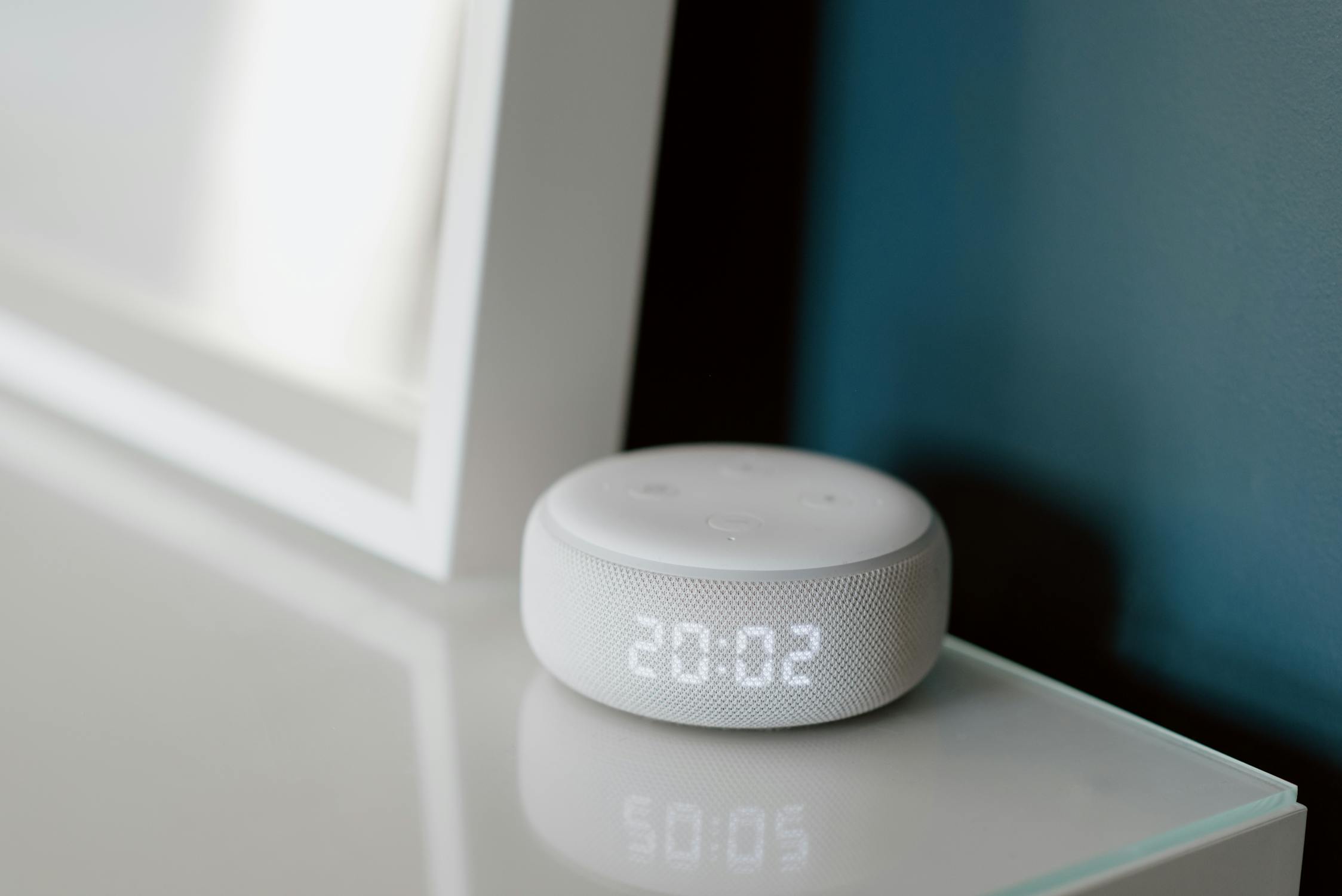
The Echo Dot with Clock (5th Generation) features an LED display showing time, temperature, and timers on the device’s fabric surface. This variant costs approximately $10 more but proves invaluable for bedside tables, eliminating the need to ask Alexa for time checks or set phone alarms. Both versions share identical audio hardware and smart home capabilities.
**Can I connect the Echo Dot to external speakers?**
Yes, the 3.5mm audio output allows connection to powered speakers, soundbars, or stereo systems via auxiliary cable. This feature benefits users wanting Echo Dot’s voice assistant capabilities while maintaining existing high-end audio setups. Additionally, Bluetooth pairing enables wireless connection to external speakers, though this introduces slight audio latency compared to wired connections.
**Does the motion detection work in the dark?**
Yes, the ultrasound motion detection functions regardless of lighting conditions because it uses sound waves rather than cameras or infrared sensors. This makes it ideal for bedroom automation or nighttime bathroom trips, triggering gentle lighting without requiring voice commands or fumbling for switches in darkness.
## Final Verdict: Is the Amazon Echo Dot Worth It?
The **Amazon Echo Dot (newest model)** successfully bridges the gap between budget smart speakers and premium audio devices. Its **vibrant sounding speaker** architecture delivers genuinely enjoyable listening experiences, while integrated sensors and smart home hub capabilities eliminate the need for multiple separate devices. At its sub-$50 price point, the value proposition becomes undeniable.
For households invested in the Amazon ecosystem, the decision requires little deliberation. The device extends Alexa’s reach while improving audio quality for existing multi-room music setups. For newcomers, it offers the most accessible entry point into voice-controlled living, with enough sophistication to grow alongside your smart home ambitions.
The optimization for **Alexa+** ensures this purchase won’t become obsolete as artificial intelligence capabilities advance. Unlike earlier generations that might struggle with forthcoming AI enhancements, the 5th Generation’s neural processing capabilities position it for years of relevant service.
Whether streamlining morning routines, controlling entertainment systems, or simply asking about the weather while cooking, the Echo Dot performs reliably with surprising audio quality. It represents not just an incremental upgrade over previous generations, but a reimagining of what an entry-level smart speaker can achieve.